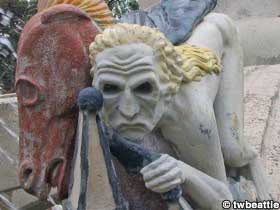
Alberto Giacometti is usually characterized as a Existential Surrealist sculpture. We all pretty much know what surrealism is cause of artists such as dali but existentialism is a little less well known. To put briefly Existentialism is a way of thought that says there is no god and human are a completely usless creature on this earth. I always enjoy this style of art because of how trippy yet truthful to our society this style of art has a tendency to be. Giacometti in particular stands out to me one, because his work consists of large scale cast metal sculptures and two, because of his use of the human form. one of his friends is quoted saying that if Giacometti did a sculpture of you your head would end up being the width of a knife blade, which is a very accurate description of his style. the bodies he creates and usually pencil thin and yet still man sized. even with such a stylized almost shadow like approach to the figure he manages to catch the correct movements of the body which give as emotion. That emotion seems to generally be a deep sense being lost and alone, even in the midst of a crowd. here are some examples of his work.
Wednesday, February 19, 2014
Sunday, February 16, 2014
Burlon Craig
Burlon Craig was an American folk potter from the Catawba River Valley in North Carolina, Craig was the last potter in the Catawba, and is credited with reviving an industry that was almost dead in the region. Catawba pottery used alkaline glazes that were made either from ground cinders (a glassy bi-product of iron smelting), or ground glass from bottles, the cinders created an earthy brown glaze, the bottles a dark green. He had no higher education, and learned the trade through apprenticeships. He is best known for his face jugs, though he did not begin to make them until later in his career. Catawba face jugs trace their roots to folk art from the Germans who settled the region.

His work is a good example of how folk art, though often looked down on, is often equal to or better than work created in academic settings in concept, quality, and function. When looking at his work one is reminded that you don't have to be educated in order to make good, sound, work, and that many of the best often never finished college.

Burlon Craig was an American folk potter from the Catawba River Valley in North Carolina, Craig was the last potter in the Catawba, and is credited with reviving an industry that was almost dead in the region. Catawba pottery used alkaline glazes that were made either from ground cinders (a glassy bi-product of iron smelting), or ground glass from bottles, the cinders created an earthy brown glaze, the bottles a dark green. He had no higher education, and learned the trade through apprenticeships. He is best known for his face jugs, though he did not begin to make them until later in his career. Catawba face jugs trace their roots to folk art from the Germans who settled the region.
His work is a good example of how folk art, though often looked down on, is often equal to or better than work created in academic settings in concept, quality, and function. When looking at his work one is reminded that you don't have to be educated in order to make good, sound, work, and that many of the best often never finished college.
Saturday, February 15, 2014
Katharine Morling
These are Katharine Morling’s hand built ceramic pieces.
Even though they are made out of clay, they might not seem like it upon first
glance. Her work reminds me of drawings or sketches and it certainly
incorporates drawn, two-dimensional elements. These pieces are like life-size
3-D line drawings, which is a really interesting concept, something that would
be even more interesting to see in person. Even though her pieces initially
seem like simple line drawings, the more you look at them the more you are
struck with the intricacies and details that went in to making each component
of every one. The way that she uses clay is fascinating!
Greg Kuharic
In his exhibition, Watershed, Greg Kuharic used gourd-form vessels, producing his own hybrid vegetable-form ceramics. He isn't interested in making realistic copies but in creating new forms using cloning different elements into shapes and surfaces that seem familiar and unfamiliar at the same time-the fact that I like this specific collection.
Thursday, February 13, 2014
Soo-Kyung Lee
Soo-Kyung Lee is made all those. She is not ceramic artist but she is just putting up all broken pieces what other people threw away. When ugly thing born new as beautiful thing, people feel better and that's when she also got comfort from this process. She is also treat her mind and recover by putting all broken pieces together. Broken pieces are white and blue which are pretty simple but with gold lines of crack, it adds some of remarkable decoration and show harmonized appearance as total so I liked her pieces.
Wayland Gregory
While I knew that there were plenty of artists in the mediums of sculpture, mural painting, and architecture that were employed by Franklin Roosevelt's Works Progress Administration, public works projects I didn't know that there were any potters. Wayland Gregory happened to be a potter who did do work for the WPA. Gregory's work seems to me to have an appeal that breaks from the norm among WPA artists. While much WPA art is stylistically in the vein of social realism, and art Deco, Gregory seems to maintain a note of these styles while creating a style all his own. Gregory's figures are dark, macabre, perhaps even ghoulish, yet colorful, all the while maintaining an air of dignity and realism found in more conventional WPA art.
Fountain of the Atoms: New York World's Fair, 1940

Light Dispelling Darkness Fountain, 1937, Edison NJ: Represents the triumph of modern science and medicine over disease and superstition.
.jpg)


Fountain of the Atoms: New York World's Fair, 1940
Light Dispelling Darkness Fountain, 1937, Edison NJ: Represents the triumph of modern science and medicine over disease and superstition.
.jpg)
Fukami Sueharu
The puerility and simplicity in Sueharu's works are incomparable, and the this dedicated artist has purified all he learned and practiced, all the hard techs, complex operational procedure into these pieces with simple but perfect lines of beauty.
Being focus on just only one form of art and not prolific, Sueharu's works are full of the respectful spirit of traditional Japanese artist. The meaning of his works are indirect, no strong, expressive message, nor appealing theme that we can find from his works. However, these works are also telling the audience their stories, in a gentle, quite tone.
Wednesday, February 12, 2014
Ai weiwei's ceramics art work of sunflower seeds!
These porcelain sunflower seeds are from Ai
weiwei (one of my favorite artist)'s ceramics art work!
There sunflower seeds are from an original set of 100 million individual porcelain
seeds, altogether weighing 150 tons.
Each was painstakingly painted by hand by
female artisans in the ancient Chinese city of Jingdezhen, renowned for more
than 1,500 years of ceramic making.
The final porcelain sunflower seed
looks from the outside to be remarkably similar to the real thing. These huge
work involved 1600 people to work on it!
Before seeing
these amazing porcelain sunflower seeds, the theme of ceramics in my mind
is really narrow.
After seeing this large-scale ceramics art work, I learned
more about ceramics. Ceramics can make into any things and any size, even a
really small size sunflower seed!
The video I found below which recalled
the whole process of making theses sunflower seeds! Please watch
this video! Its really interesting!
Monday, February 10, 2014
There are many incredible artists who's work with clay has very inspirational for me. However, I think the most inspirational work i have ever seen was done by Richard Nockin. My favorite of his works are the teapots he makes using the slip cast method. He starts with a block of clay and creates the most life like representations i have ever seen. They usually have a sense of humor to them that comments on society. Once he is finished with the design he makes multipart plaster molds, which from experience i know is incredibly difficult to do. then he uses slip clay to create hundreds of hollow form vessels. The thing that inspires me the most about his work is his balance of dizzying detail with a quality of incredible technique and he still manages to fit conceptual ideas into his work. If i recall correctly the university of Iowa art museum actually has one of his pieces if ya want to go check it out. here are some examples of his work as well.
Friday, February 7, 2014
Mitchell Grafton
This hand-crafted ceramic (13'' tall) made by Mitchell Grafton is one of the styles that I prefer-playful. I don't see how this could be functional or practical, but it's successful in a way that expresses a strong sense of emotion (frustration, fear, anxiety?) I hope I could create something like this in the future.
Tuesday, February 4, 2014
Heidi Casto
Heidi Casto is my teacher and at same time, is one of my favorite ceramic artist. She married with Andy Casto who is also ceramic artist. I like her work because of her expression on animal's exaggerated and comical like cartoon characters. Also dots that covered of animal can show the texture of the animal's skin and shape more volume. Her work is again, my favorite :)
Joanna Howells
Joanna Howell is an artist from the UK who
makes porcelain pottery. After she
throws she alters the forms she has made by working with and stretching the
clay. I really like the way her pieces look. They are clean and graceful, while
their stretched and manipulated surfaces give them movement, allowing them to
have lively and organic qualities. Many times she uses very light bluish
greenish colors that contribute to their soft, neat characteristics.
Friday, January 31, 2014
Clay 2 class
This week I have been throwing clay on the wheel. It is a lot harder than I thought it would be but I am defiantly starting to get the hang of it. My problem is I find it is hard to throw my weight in to the clay to get it perfectly centered. When I finally think my clay ball is finally centered I begin to form the bowl or cup, etc that I am trying to create. I also find that it is hard to build up like a cylinder because when I attempt to do so my cylinder gets all wonky at the top then I have to either cut off the top the best I can or start over. So... I know what I'm doing this weekend.
Thursday, January 30, 2014
Jade Gallup
What a hilarious claywork.. I personally love 3D art that has a sense of humor, which explains why these caught my attention. These Porcelain Dog themed accessories are Jade Gallup's.
Nancy Denommee
Nancy Denommee created this piece with polymer clay and mold. It seems really graphic and cartoonish. Also putting clock inside of eye is interesting idea and mainly I like the color and that the small little things put together to make one circular shape of eye.
Monday, January 27, 2014
Kate MacDowell
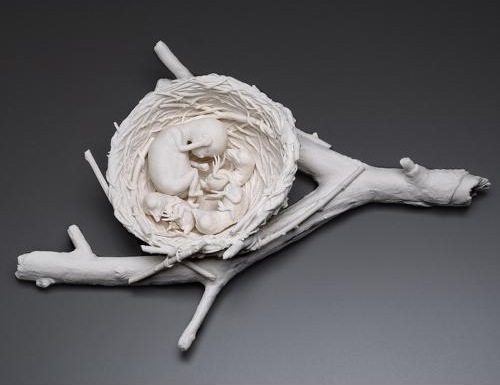
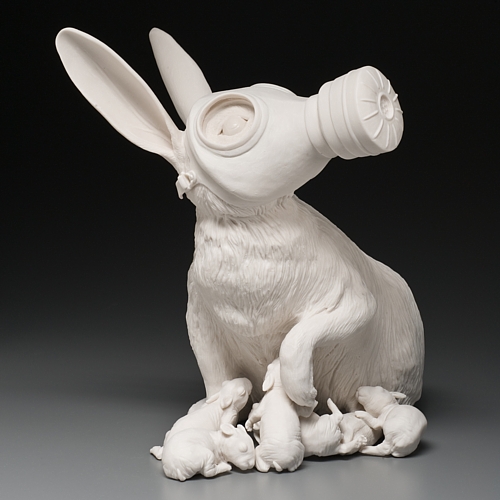
Many of Kate MacDowell's works are white 3D porcelain sculptures, but what I like about her art is her transformation of a somewhat mundane or common objects/living creatures into unusual, whimsical art.

Saturday, January 25, 2014
Sophie Kahn
Sophie Kahn is an artist that uses 3D scanners and printers
in her art. I think it is neat how she combines both new and old processes when
creating her work and how the outcome reflects this. The pieces are an
interesting juxtaposition of old and new. The artwork is fragmented as a result
of the 3D scanner. Once she has the 3D printed object, she uses it to make
sculptures using ancient casting techniques. She brings together such
contrasting processes, ancient and cutting edge, to make something new.
Thursday, January 23, 2014
Evelyn Bracklow
Evelyn Bracklow, a German artist, created a number of traditional porcelains called "Chitins Gloss." At first, I thought the army of ants were literally crawling up the porcelain--this shows how playful the artist is and how the artworks turned out so realistic and exquisite. Some of her collections are for sale, which I definitely want to purchase one of them!
Wednesday, January 22, 2014
Sónia Soeiro's Peel 3d Ceramic Art
Sónia Soeiro creates 3D art for Industrial Design, Product Design, and Furniture Design. Her 'Peel Ceramics' project is an idea for a tea set in which the ceramic pieces look as though sections are peeled away. The peeling effect creates a space for functional use and visual aesthetic pleasure.
https://www.behance.net/gallery/Descascar-ceramica-Peel-ceramics/8520923
- Cassie Wenger
"In this set I explored conceptually the idea of peeling associated to the fact that each washing of objects results in peeling of layers, like a skin removed of objects each time they are washed."
https://www.behance.net/gallery/Descascar-ceramica-Peel-ceramics/8520923
- Cassie Wenger
Subscribe to:
Posts (Atom)