Sunday, December 15, 2013
Zen Parry
Parry's work is based off her signature triangular shape which resembles the dark corners of the human psyche, aka the thought you would rather not confront. She does not use the wheel or a kiln, and all components are hand made. I find her pieces to be very interesting to look at because they are a very uncommon way to create art. I honestly would have never even known that she was a ceramicist. Each piece is to resemble the place of where she was inspired to create it.Halima Cassell
Halima Cassell's work is primarily geometric patterns influenced by African and Islamic art. They are all unglazed clay, which definitely gives them a naturalistic look. She carves out the patterns into the clay and then fires them. They are definitely eye catching because the patterns are detailed.
Beate Kuhn
Beate Kuhn is known mostly for her sculptures made from her wheel thrown multiples. Her work is very original, and organic. She stays with mostly neutral colors and some soft blues. Her pieces are very modern, yet intricate. Visually, they are interesting to look at, because they are so unique.
Saturday, December 14, 2013
Ian Garrett
Ian Garrett is a potter from South Africa. I think that
these pots/bowls are beautiful. The forms of the pieces are rather simple and allow
the interesting textures to have prominence. The juxtaposition between the
shiny and textured surface makes them quite eye catching and captivating. To
me, these don’t even really look like clay; there must be such time-consuming
and unique finishing techniques involved. I read that the artist builds his pieces
with coils, and that burnishing with pebbles creates the shiny parts.
Rachel Suzanne Smith
Smith uses mediums and ideas from nature. She literally puts grass into her pieces to emphasize the nature aspect of the pieces. Smith doesn't use bright colors or crazy patterns to catch the attention of her viewers. Smith raises her metals to make the bumps and texture. She uses organic shapes rather than something traditional which goes along with the nature aspect of her work.

Smith uses mediums and ideas from nature. She literally puts grass into her pieces to emphasize the nature aspect of the pieces. Smith doesn't use bright colors or crazy patterns to catch the attention of her viewers. Smith raises her metals to make the bumps and texture. She uses organic shapes rather than something traditional which goes along with the nature aspect of her work.
Ben Dory
Dory loves patterns. In his artist statement he says that he "is fascinated by the ability to transform a surface through pattern." His work caught my eye because of the colors and patterns. His pieces all have a uniform, symmetric look to them that is very pleasing to the eye. I am also a fan of Dory because he is from a small area of Illinois that I have been too before.

Dory loves patterns. In his artist statement he says that he "is fascinated by the ability to transform a surface through pattern." His work caught my eye because of the colors and patterns. His pieces all have a uniform, symmetric look to them that is very pleasing to the eye. I am also a fan of Dory because he is from a small area of Illinois that I have been too before.
Tanel Veenre
Veenre is from Tallin, Estonia which is a small place in Northern Europe. His work is definitely something unique. The main medium that Veenre uses is wood to create this big statement pieces. The pieces seem to have a bump like texture on them. The colors are dark and more subtle pieces but the design of the shapes is what gives these pieces the statement aspect. Veenre has gotten a lot of his influence from Estonia.
Here is the link: http://klimt02.net/jewellers/tanel-veenre
Veenre is from Tallin, Estonia which is a small place in Northern Europe. His work is definitely something unique. The main medium that Veenre uses is wood to create this big statement pieces. The pieces seem to have a bump like texture on them. The colors are dark and more subtle pieces but the design of the shapes is what gives these pieces the statement aspect. Veenre has gotten a lot of his influence from Estonia.
Here is the link: http://klimt02.net/jewellers/tanel-veenre
Manuela Sousa
Sousa is from Portugal and her heritage shows through immensely in her work. She uses all forms to create her jewelry. She uses silver, cotton, and steel for some and then for a couple of brooches she used matches. Another couple sets of brooches were crafted using elastic bands that resemble hair ties that people use to hold their hair back. Her pieces are familiar shapes that most people can identify. She does squares, hearts, and oval for a lot of the main shapes. I was drawn to this work by how simplistic the work seems.
Here is the link to her site :http://klimt02.net/jewellers/manuela-sousa
Sousa is from Portugal and her heritage shows through immensely in her work. She uses all forms to create her jewelry. She uses silver, cotton, and steel for some and then for a couple of brooches she used matches. Another couple sets of brooches were crafted using elastic bands that resemble hair ties that people use to hold their hair back. Her pieces are familiar shapes that most people can identify. She does squares, hearts, and oval for a lot of the main shapes. I was drawn to this work by how simplistic the work seems.
Here is the link to her site :http://klimt02.net/jewellers/manuela-sousa
Tamara Gruner
Her work caught my eye because she has her pieces modeled on dogs. My first thought was that this was animal jewelry and that I have never seen such a thing apart from maybe a dangle on a collar or leash. After further investigation I realized that these were bright, vibrant pieces. The look of the big statement pieces and the bright colors reminds me of a high end type of costume jewelry. Her pieces lack symmetry which adds to the overall flavor of the pieces and most of the work is a earth tone with a pop of color by using a jewel or some other medium.
Here is her website: http://klimt02.net/jewellers/tamara-gruner
Her work caught my eye because she has her pieces modeled on dogs. My first thought was that this was animal jewelry and that I have never seen such a thing apart from maybe a dangle on a collar or leash. After further investigation I realized that these were bright, vibrant pieces. The look of the big statement pieces and the bright colors reminds me of a high end type of costume jewelry. Her pieces lack symmetry which adds to the overall flavor of the pieces and most of the work is a earth tone with a pop of color by using a jewel or some other medium.
Here is her website: http://klimt02.net/jewellers/tamara-gruner
Darlene Armstrong
My main focus in art is metal and jewelry. The craft of pieces are so mechanic and take much precision either when cutting out or hot/cold connecting. The simplest looking pieces generally are the most complicated to make. Armstrong is an artist from Denver, Colorado. She uses glass in her pendants and necklaces and advertises that each piece is handmade and unique to the nest. I love the softness of the colors that she uses. These aren't bold, bright statements but rather they are intricate pieces that have their own hold on beauty.
Her in the link to her pieces. http://www.gallery386.com/large-multi-view/Silver%20and%20Handmade%20Glass/790821-2-61081/Jewelry.html
My main focus in art is metal and jewelry. The craft of pieces are so mechanic and take much precision either when cutting out or hot/cold connecting. The simplest looking pieces generally are the most complicated to make. Armstrong is an artist from Denver, Colorado. She uses glass in her pendants and necklaces and advertises that each piece is handmade and unique to the nest. I love the softness of the colors that she uses. These aren't bold, bright statements but rather they are intricate pieces that have their own hold on beauty.
Her in the link to her pieces. http://www.gallery386.com/large-multi-view/Silver%20and%20Handmade%20Glass/790821-2-61081/Jewelry.html
Friday, December 13, 2013
Barbara Nanning
Barbara Nanning tends to base her pottery off of flowers, plants, microcosm. Her pieces are not identical to the objects she bases her work off of, but you get the sense of what she is creating. Her pieces are bright and vibrant, just like flowers are. They are curvy and abstract, and draw your attention to them. They create many shadows and the light seems to make them more interesting to look at.
Kurt Weiser
I really enjoyed looking at Kurt Weiser's porcelain pieces, not necessarily for the pottery aspect of it, but because his painting on the surfaces is stunning. His color choice is so realistic, yet even though the figures are distorted, they are almost real. His style is really unique, you don't see many ceramic artists using their pieces as a canvas to paint elaborate images.
Minerva Chango
Most of Minerva Chango's work is wood fired, which gives it a rustic texture and color. She does a lot of curvaceous pieces as well as tea pot looking objects. The colors she tends to use throughout her work are naturalistic, calm colors, with a little bit of energy. Her work seems to look almost accidental when it comes to her glazing, but it seems to bring a uniqueness to each piece.
Vivienne Foley
Vivienne Foley is an exceptional ceramicist in London. Her very unique, original, modern pieces are unlike anything I have seen. Every piece is precise. They are very unusual pieces, usually of black or white, made from porcelain. I must say I love the curves and points and individualism of each piece. They are definitely fit into the category of modernism.
Thursday, December 12, 2013
Andrea Fabrega
What's not to love about miniature ceramics? Andrea makes these very small ceramic pieces using porcelain. She does throw them on a full sized wheel.
Robert Arneson
Robert Arneson started the Funk Ceramics movement, but I really enjoy his drawings. I love the use of color, as well as the size and close up subject matter. His work was on display at the art museum in the IMU earlier this year.
Eva Hesse
Hesse didn't live very long, nor did she create and enormous body of work, but she pioneered interesting takes on sculpture, using thread and plastics in a lot of her work.
Regina Granne
Granne's drawings frequently address social issues in a subtle but well rendered way, and her concepts are always thought provoking.
Yayoi Kusama
I love the way this artist uses pattern as an illusion and for texture. Plus, her images are an interesting combination of serious and silly.
Fiber Sculpture
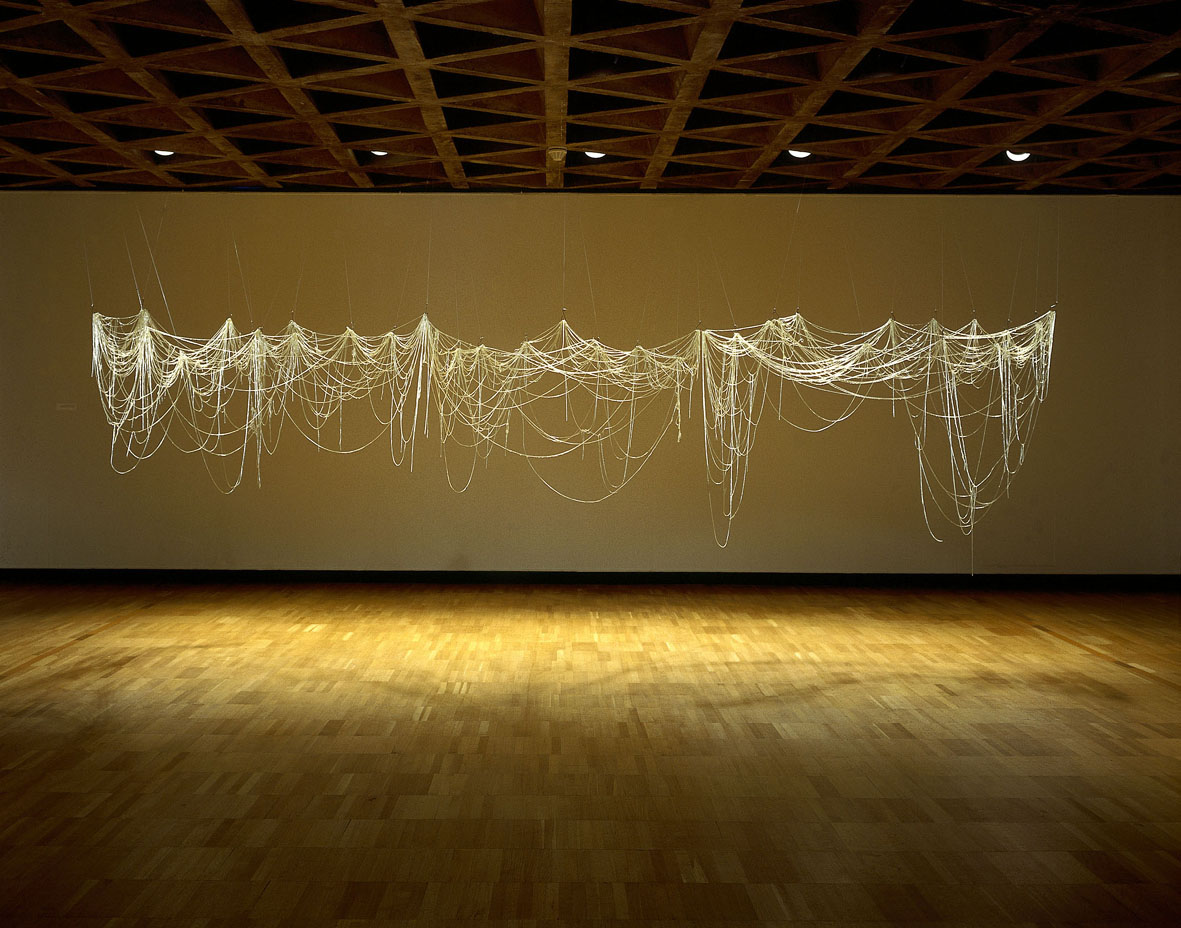
This piece of art, called 1.26, was created by Janet Echelman. It was a temporary sculpture, located in Denver from July 6th through August 6th 2010. During that time it was suspended from the roof of the seven story Denver Art Museum.
It was made using a special fiber and illuminated with bright colored lights. I think the color in the piece is absolutely amazing and I really enjoy its fluid form. I really wish I could have seen it lit up and moving in the wind in real life.
Wanda Fiscina
None of the information on this artist was in English, but I
still wanted to share her pieces. This one looks like a sea creature.
Alice Ballard
Alice Ballard is a well known ceramicist based in Greenville
South Carolina. Her work is inspired by nature and the changing seasons. She
has several permanent collections. I especially like her teapots.
This is a piece from her wall pod collection.
This is her long pod trio.
Betsy Nield
Astrid Dahl
Robin Welsch
Robin Welch is a ceramicist from Britain. He’s been working
since the 80’s. I like the very functional, and earthy feel of his work.
I like how this tumbler has a very aged look, with a gold
rim. It also has a unique shape, It looks like it could have been found in an
archeological site.
This bowl has the same look. It has beautiful colors, and
I’d like to know how he fired these pieces.
I love way he shaped the pitcher in this set. They’re a very
elegant set, while still having Welch’s characteristic aged look.
Michel et Nico
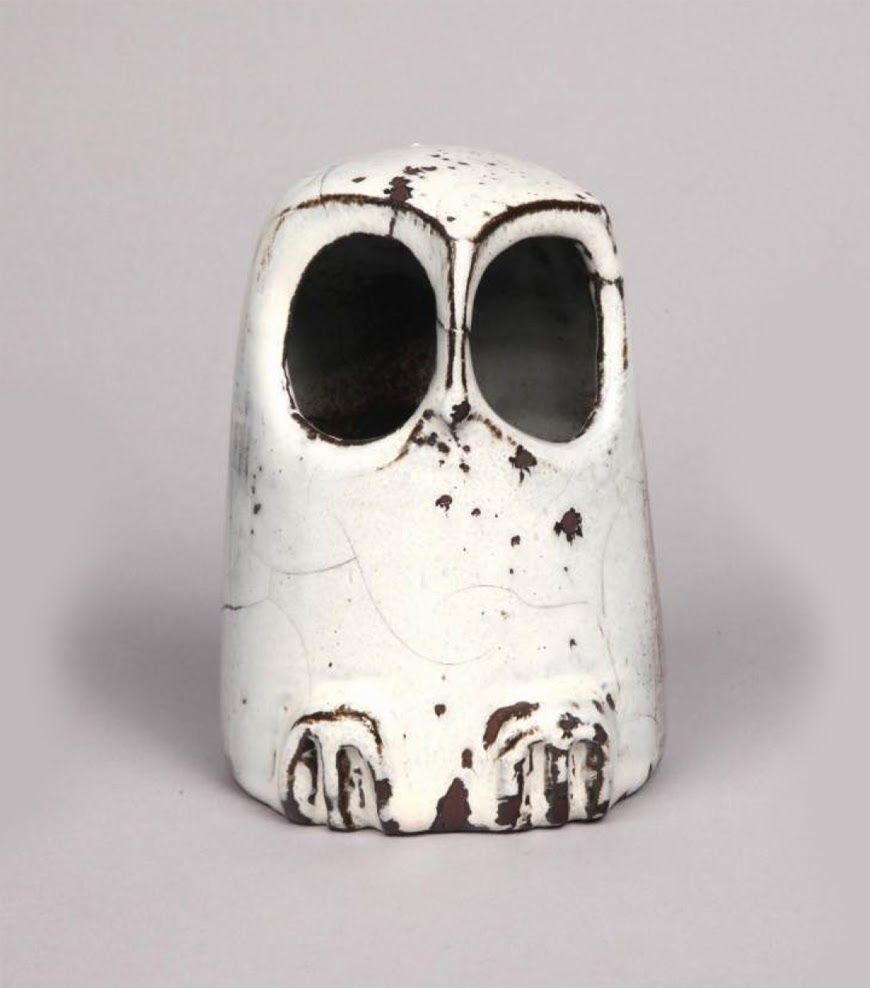
I couldn’t find a lot of information on the artist, other
than that he was a French artist in the 60s/70’s, but I wanted to share these
pieces. They are at the same time absolutely adorable, and a little morbid.
They shift between looking like cartoon characters and skulls. I like how the
artist took a handful of characteristic traits of an owl, and made a bunch of
unique sculptures. They are all drastically different, but obviously owls.
Subscribe to:
Posts (Atom)